Quick Answer
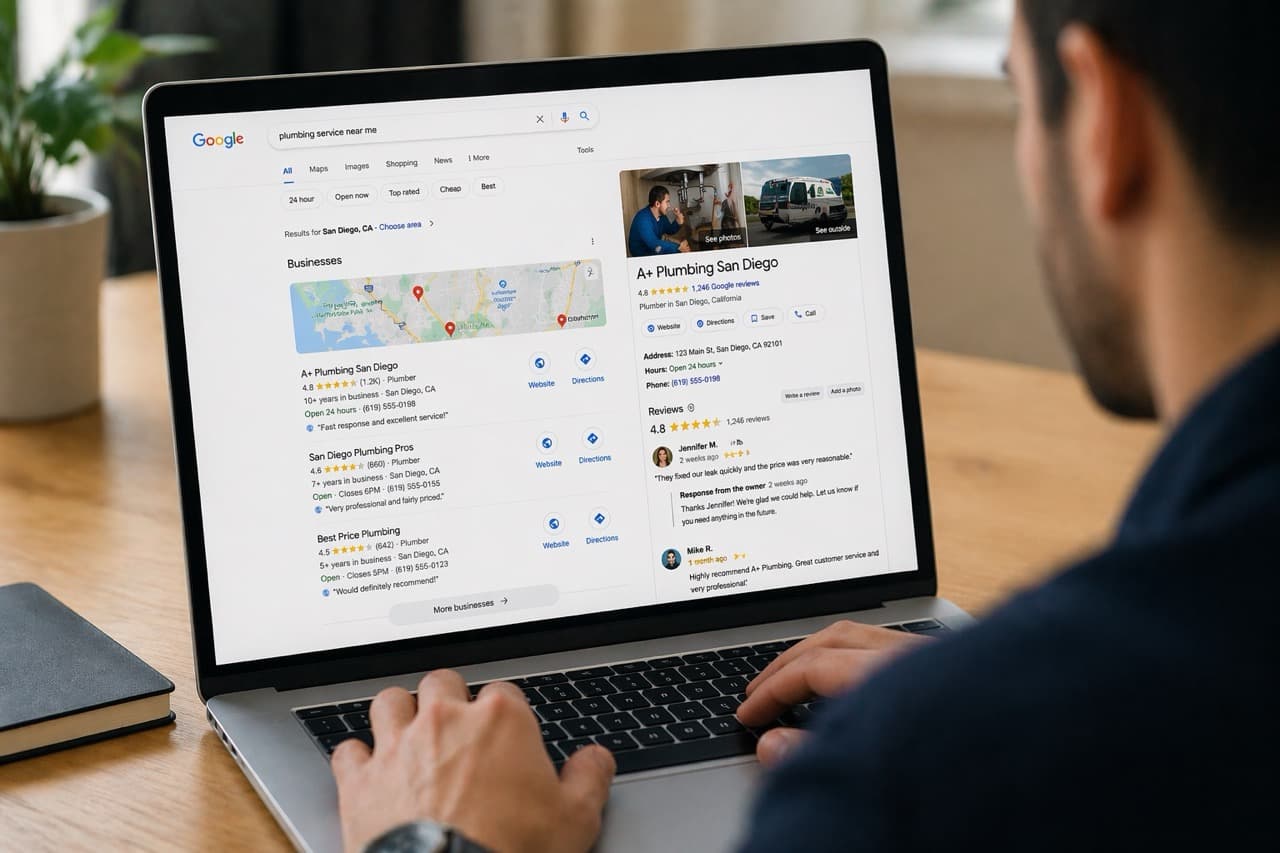
Yes, responding to Google reviews helps local SEO. Google has officially confirmed that engaging with customers — including replying to reviews — contributes to your local ranking signals, but the effect is indirect and compounds over time. The businesses winning the local pack aren't just collecting stars; they're actively responding to every review within 24-48 hours.
- Engagement signal: Active replies tell Google your profile is alive and managed
- Keyword surface: Responses create indexed content with your service and location terms
- Review flywheel: Customers who see responses are more likely to leave their own reviews
The short answer: yes, here's why
There's a pattern in competitive local markets. A plumber with 180 reviews and a 4.4 rating consistently outranks another plumber with 220 reviews and a 4.7 rating. The difference, once you dig in, usually comes down to one thing: the first business responds to every review. The second almost never does.
Review responses feed three things Google cares about in local search:
- Profile activity: A business that replies consistently signals it's operational and engaged — not a dead listing
- Engagement metrics: Profile views, clicks, and direction requests all increase when responses are visible in search results
- Content freshness: Every response is new text that Google can index, reinforcing relevance signals for your service type and location
None of these are magic bullets on their own. But stacked together, over months, they create a meaningful gap between you and competitors who ignore their review inbox.
Does responding to Google reviews affect local ranking?
Yes — with an important distinction. Responding to reviews most directly affects your local pack ranking (the Google Maps 3-pack that appears above organic results). The effect on pure organic blue-link rankings is more limited, since those are driven primarily by your website's content and backlink profile.
For local pack rankings, Google weighs three factors: relevance, distance, and prominence. Review activity — including response behavior — falls under prominence. An actively managed profile signals that the business is legitimate, operational, and worth surfacing to searchers.
Does responding to reviews affect local search ranking?
It does. Google's own guidance on improving your local ranking specifically lists "respond to reviews" as a recommended action. While Google stops short of naming it a direct ranking signal with an assigned weight, the correlation between consistent response behavior and higher local pack positions is well-documented. BrightLocal's research shows review signals — including engagement — now account for roughly 16-20% of local ranking factors, up from earlier estimates.
Does replying to reviews improve local SEO ranking?
Here's the honest version: response activity alone won't rescue a weak profile. If you have 8 reviews and your competitor has 200, replies won't bridge that gap. But if you're roughly matched on review volume and rating, consistent responses can and do tip the scales.
The mechanism that gets underestimated most is indexed content. When you respond to a review, that response appears on your Google Business Profile — and Google indexes it. A response that naturally includes your service type ("glad you enjoyed your oil change") and location ("right here in Austin") adds to the body of text Google uses to match your profile to search queries.
Done across dozens of reviews over several months, this creates a meaningful layer of keyword-rich, freshly updated content that pure review collection doesn't provide. You can't ask customers to include specific keywords in their reviews, but you can write responses that do exactly that — naturally and authentically.
The 4 SEO benefits of replying to Google reviews
1. Engagement signal — Google sees an active profile
Google's local algorithm weights interaction on your profile. Businesses that reply to reviews consistently trigger more profile visits, calls, and direction requests — and Google reads those downstream actions as evidence of real-world relevance. It's a self-reinforcing loop: responses drive engagement, engagement drives rankings, rankings drive more profile visits.
2. Keywords in responses — natural placement of service and location terms
A response like "Thanks for trusting us with your HVAC installation, Sarah — our team in Denver works hard to make every job count" does several things at once. It's genuine customer service, and it also quietly reinforces "HVAC installation" and "Denver" as terms associated with your profile. Done naturally across hundreds of reviews, this adds up.
The caveat: stuffing responses with phrases like "best plumber in Seattle" reads as spam to both customers and Google. Keep it conversational. Reference what the customer actually mentioned.
3. Review volume and recency — responses prompt more reviews
When potential customers scroll your profile and see that you respond to every review thoughtfully, they're more likely to leave their own. This is the review flywheel: active responses signal that feedback is read and valued, which drives more reviews, which drives more ranking signals. BrightLocal found that 88% of consumers are more likely to use a business that replies to all reviews, versus just 47% who'd use a business that never responds.
4. CTR from search — responses are visible before the click
In Google search results and Maps, your most recent responses are often visible at a glance. A business profile showing "Owner replied 2 days ago" projects responsiveness before the user even clicks through. Higher-trust profiles get more clicks. More clicks improve your position. It compounds.
What Google has officially said
Google is unusually direct about this for a company that typically guards its ranking logic closely. From their official Google Business Profile help documentation on how to improve your local ranking:
"Respond to reviews that users leave about your business. When you reply to reviews, it shows that you value your customers and their feedback. High-quality, positive reviews from your customers can improve your business visibility and increase the likelihood that a shopper will visit your location."
That last sentence is the key: visibility and foot traffic — the outcomes that matter — are explicitly tied to both positive reviews and the act of responding to them.
Google also lists "interacting with customers" as part of what keeps a Google Business Profile active and relevant. A profile with recent responses, updated photos, and current hours looks alive to Google's algorithm. A profile with 3-year-old reviews and zero owner activity looks like a business that may not even exist anymore.
Does responding to negative reviews help SEO too?
Yes — and in some ways, responding to negative reviews has more impact than responding to positive ones.
Here's why: a thoughtful response to a 1 or 2-star review demonstrates professionalism in a way that's highly visible to undecided customers. It signals that the business takes accountability seriously. That trust signal affects conversion, and conversion rates affect rankings.
There's also a practical angle: a responded-to negative review carries less weight in dragging down your overall perception than an ignored one. Customers read negative reviews differently when they see a real response. Studies show that 33% of customers who received a substantive response to their negative review subsequently posted a positive one.
For a full breakdown of how to handle critical reviews in a way that protects your reputation, see our guide on how to respond to negative Google reviews.
How fast do you need to reply for SEO benefit?
The industry benchmark is within 24-48 hours. That's not arbitrary — it's based on what customers actually notice. A review that sits unanswered for a week feels ignored. A reply that shows up the next morning feels attentive.
For Google's algorithm, the freshness signal is less about hitting a specific hour threshold and more about consistent behavior over time. A business that replies to everything within a day looks very different to Google's engagement model than one that responds in batches every three weeks.
This is where most businesses fall behind. Manual review management means reviews pile up, replies happen when someone finds time, and the profile looks inconsistent. Tools like RepliFast generate on-brand replies in seconds — so the 24-hour window becomes the default rather than the aspiration. The profile stays active regardless of how busy things get on the operations side.
How to reply to reviews in a way that actually helps SEO
There's a difference between replying and replying well. Here's the practical breakdown:
What to do
- Use natural keywords. Weave in your city, service type, and business name where they fit naturally. "Glad you enjoyed your teeth cleaning with our Denver dental team" is better SEO than "Thanks for the review!" — and it's still genuine.
- Be specific. Reference what the customer actually mentioned. "Happy your lasagna hit the spot on date night" beats a generic acknowledgment every time.
- Reply to every review. Selective responding (only the good ones) signals inconsistency. Aim for 100%.
- Keep it concise. 2-4 sentences is ideal. Long replies look performative.
What to avoid
- Keyword stuffing. "Thank you for visiting the best hair salon in Chicago, Illinois for the best haircut in Chicago" is a spam flag, not an SEO boost.
- Copy-paste templates. Generic "Thank you for your feedback! We appreciate your business!" responses signal low effort to both customers and the engagement signals Google tracks.
- Defensive replies to negatives. These hurt conversion and trust, which indirectly hurts rankings.
The challenge for most businesses is consistency — keeping the quality high when you're also running operations. RepliFast's review reply generator learns your brand voice and generates replies that sound like you wrote them: specific, on-brand, and naturally including relevant service and location context. It's built for the business owner who knows they should be responding but never has time to do it well.
See also: how automated Google review responses work and why replying to reviews is critical for your reputation.
Frequently Asked Questions
Does replying to Google reviews help SEO?
Yes. Responding to Google reviews contributes to local SEO through profile engagement signals, content freshness, and keyword reinforcement in indexed responses. The effect is indirect but measurable over time, particularly for local pack (Google Maps) rankings.
Does responding to Google reviews affect local ranking?
Yes. Review activity — including owner responses — falls under "prominence" in Google's local ranking model. Consistent response behavior signals an active, legitimate business, which improves visibility in local search results and the Google Maps 3-pack.
Does responding to Google reviews improve local SEO ranking?
It contributes to improved local SEO ranking, particularly when combined with a healthy review volume and competitive rating. Responses add indexed content, drive engagement metrics, and encourage more reviews — all of which are known local ranking signals.
Do owner responses to Google reviews affect local ranking?
Yes. Google explicitly recommends responding to reviews as a way to improve your local ranking. Owner responses are visible in search results, increase profile engagement, and create fresh indexed content — three factors that positively influence local pack position.
Does responding to reviews improve Google ranking?
For local search rankings (Google Maps, local pack), yes. For broader organic blue-link rankings, the effect is more limited. Review responses are primarily a local SEO signal rather than a traditional website SEO signal.
Does Google review response help SEO?
Yes. Each response is indexable content associated with your Google Business Profile. Over time, responses that naturally include service types, location names, and business context add to the keyword relevance Google uses to match your profile with search queries.
How long do SEO benefits of replying take to show up?
Early engagement improvements (profile views, CTR) can appear within weeks of consistent responding. Ranking movement in competitive categories typically takes 2-4 months of sustained activity before it becomes statistically visible. The effect compounds — the earlier you start, the larger the advantage builds.
How often should I reply to reviews for SEO?
Reply to every review, ideally within 24-48 hours of it posting. Consistency matters more than frequency — a 100% response rate over 3 months signals a more active profile than sporadic batches of replies. There is no benefit to replying more than once per review.
Reply to every review in your brand voice — automatically
RepliFast generates on-brand Google review replies in seconds. Set up your brand voice once, and every reply sounds like you — specific, professional, and naturally SEO-friendly. Start free, no credit card required.
Try RepliFast Free →5 free AI replies per month, forever. No credit card required.